1
a show 5
b programme 3
c bulletin 1
d opera 4
e forecast 2
2
a How many times have I been telling you not to leave the windows open?
b (correct)
c I'm doubting that Suzie has been learning French for more than a few months.
d I'm not buying that book - it's costing too much!
e (correct)}
f I don't understand why you don't enjoy this meal - it's delicious!
3
a -, -
b -, the
c a, -
d an, the
e the, a
f -, -, an, the
4
a The chances are that it will rain. 3
b There's no way that I'll pass this exam. 1
c It's unlikely that we'll get home before midnight. 2
d He's bound to phone sooner or later. 4
5 (Suggested answers)
a Please don't tell anyone.
b Put your hands on your head!
c How do you make curry?
d I'll help you with your homework.
e I think you should apply for the job. / You ought to apply for the job.
f You mustn't contact the police. / You'd better not contact the police.
6
a underdressed
b anti-war
c remake
d overconfident
e misplaced
f semi-detached
7
1 engine
2 ignition
3 steering wheel
4 roof
5 boot
6 windscreen
7 brakes
8
1 Would
2 Could
3 ought to
4 could
5 May
6 must
9
a As
b in case
c even though
d unless
e Since
martes, 4 de diciembre de 2018

UNIT 6 JOURNEYS (Workbook, pp. 39-41): Answer Key
Grammar
1
1 b couldn't
2 d can
3 f ought
4 a must
5 e can't
6 c should
2
a We aren't / We're not allowed to wear jeans at this school.
b Swimming is prohibited in this part of the river.
c Using a dictionary in the exam is against the rules.
d It's against the law (in the UK) for children under 13 to work (in the UK).
e The use of mobile phones in some train compartments is forbidden./is forbidden in some train compartments.
3
a Can, Could, Would
b cannot, may not
c Can, Could, May
d Would
e can, could, would
f can, could, may
Listening
1
a 4 b 2 c 6 d 3 e 8 f 1 g 7 h 5
2
1 B 2 B 3 C 4 A 5 B 6 C 7 B 8 A
Use of English
1
a even though
b as
c whether
d unless
e in case
f whereas
g after
2
a UNLESS WE GET
b AFTER HER FAMILY MOVED
c AS HE WALKS/HE'S WALKING HOME
d IN CASE YOU LOSE
e EVEN THOUGH THE WEATHER
f WHETHER WE WANT TO
REVIEW (Student's Book, p. 80): Answer Key
1
a visa
b ferry, scooter
c bus driver, ticket
d flight attendant, hand luggage, overhead lockers
2
a pick up
b change
c got into
d cancelled
e board
3
a You must wear a helmet when you're riding a motorbike.
b From our first floor apartment, we could hear noises in the street below.
c We couldn't reach the airport in time.
d May I have a seat by the aisle?
e You shouldn't drink the tap water when you're staying in a hotel.
f You don't have to tell me, I already know where you've been!
g Only seven students could finish the exam within the time allowed.
h She should/ought to/must visit the Eye museum while she's in Brazil.
4
1 as well as
2 whereas
3 Since
4 as though
5 in order that
6 whether
5
a DIDN'T COME UP TO
b WENT FROM BAD
c NOTHING CAME TO
d DON'T COME EASILY
a visa
b ferry, scooter
c bus driver, ticket
d flight attendant, hand luggage, overhead lockers
2
a pick up
b change
c got into
d cancelled
e board
3
a You must wear a helmet when you're riding a motorbike.
b From our first floor apartment, we could hear noises in the street below.
c We couldn't reach the airport in time.
d May I have a seat by the aisle?
e You shouldn't drink the tap water when you're staying in a hotel.
f You don't have to tell me, I already know where you've been!
g Only seven students could finish the exam within the time allowed.
h She should/ought to/must visit the Eye museum while she's in Brazil.
4
1 as well as
2 whereas
3 Since
4 as though
5 in order that
6 whether
5
a DIDN'T COME UP TO
b WENT FROM BAD
c NOTHING CAME TO
d DON'T COME EASILY
jueves, 4 de octubre de 2018
REVIEW UNITS 1-3 (Workbook, pp. 22-23): Answer Key
1
a up
b -, out
c in
d out, up
e -, off
f on, out
g -, -
h up, back
2
1 'll have been working
2 'm going to take / 'm taking / 'll be taking
3 're going
4 does ... leave
5 'll be sitting
6 will ... have finished
7 'll leave
3
a look
b set
c look
d set
e set
f look
g look
h set
4
a paid through the nose
b he's lying through his teeth
c she's giving me the cold shoulder
d behind my back
e behind his back
5
a singing
b spending
c to write
d grab, run off
e to get
f eating
6
a after a fashion
b At first sight
c 've been out of touch / haven't been in touch
d for the best
e On balance
7
a bitterly
b desperately
c perfectly
d stunningly
e wildly
f seriously
8
a pull yourself together
b pull through
c pull off
d pull apart
e pull over
9
a have ... been learning, started
b phoned, had just gone out
c had ... been digging
d Have ... ever been, 've been
e used to write
f 've already phoned
a up
b -, out
c in
d out, up
e -, off
f on, out
g -, -
h up, back
2
1 'll have been working
2 'm going to take / 'm taking / 'll be taking
3 're going
4 does ... leave
5 'll be sitting
6 will ... have finished
7 'll leave
3
a look
b set
c look
d set
e set
f look
g look
h set
4
a paid through the nose
b he's lying through his teeth
c she's giving me the cold shoulder
d behind my back
e behind his back
5
a singing
b spending
c to write
d grab, run off
e to get
f eating
6
a after a fashion
b At first sight
c 've been out of touch / haven't been in touch
d for the best
e On balance
7
a bitterly
b desperately
c perfectly
d stunningly
e wildly
f seriously
8
a pull yourself together
b pull through
c pull off
d pull apart
e pull over
9
a have ... been learning, started
b phoned, had just gone out
c had ... been digging
d Have ... ever been, 've been
e used to write
f 've already phoned
miércoles, 3 de octubre de 2018
UNIT 3 WHAT'S SO FUNNY? (Workbook, pp. 16-21): Answer Key
Reading
1
a Mumbai, Dr Kataria
b around an hour and a quarter
c 27,000 children and their families
2
1 B 2 G 3 A 4 C 5 F 6 E
Vocabulary
1
a 3 b 6 c 5 d 1 e 4 f 2
2
a perfectly honest
b stunningly beautiful
c bitterly disappointed
d desperately close
e wildly inaccurate
f seriously injured
3
a ... doctors expect him to pull through.
b ... he pulled them apart.
c ... he pulled over.
d ... I pulled myself together.
e ... they pulled it off.
Grammar
1
1 a 2 a, b 3 b 4 a, b 5 b 6 b 7 b 8 a, b
2
1
A: Have you ever been to China?
B: Yes, I have. I went there last year.
A: What did you think of it?
B: I loved the countryside but I didn't like the cities.
2
A: I'm sorry I'm late. Have you been waiting long?
B: No, I haven't. I arrived late too!
A: Has the show started yet?
B: No, not yet. In fact, only half of the audience has arrived so far.
3
A: Did you see Sammy last week?
B: Yes, on Tuesday. He'd just arrived back from holiday.
A: Oh, that's right. He went to Italy to pick grapes.
B: Yes. He told me that he'd been speaking Italian so much that he'd forgotten his English.
3
1 gave
2 had prepared
3 had been
4 began
5 remembered
6 had left
7 took
8 had made
9 printed
10 had helped
11 opened
12 had written
Listening
1
1 B 2 A 3 A 4 A 5 B 6 B 7 A 8 C
2
1 expensive 2 chapters 3 guests 4 portions 5 angry 6 laugh 7 possessions 8 significant
Use of English
1
a NO b NO c YES
2
1 A 2 B 3 B 4 D 5 B 6 D 7 C 8 C
REVIEW (Student's Book, p. 44): Answer Key
1 (Suggested answers)
very dirty = filthy
very clean = spotless
very tired = exhausted
very surprised = amazed, astounded
very attractive = gorgeous
very hungry = starving
very bad = dreadful, terrible
very small = tiny
2
1 b 2 a 3 a 4 b 5 b
3
a put me off
b putting me down
c put up
d Put away
e put across
f putting it on
g put in
h put you up
4
1 B 2 C 3 A 4 B 5 D 6 C 7 B 8 D
very dirty = filthy
very clean = spotless
very tired = exhausted
very surprised = amazed, astounded
very attractive = gorgeous
very hungry = starving
very bad = dreadful, terrible
very small = tiny
2
1 b 2 a 3 a 4 b 5 b
3
a put me off
b putting me down
c put up
d Put away
e put across
f putting it on
g put in
h put you up
4
1 B 2 C 3 A 4 B 5 D 6 C 7 B 8 D
martes, 11 de septiembre de 2018
SOME RELIABLE ONLINE DICTIONARIES
I highly recommend using the following online dictionaries: (Click the links)
Cambridge Dictionary
WordReference
Longman Dictionary of Contemporary English
Macmillan Dictionary
Merriam-Webster Dictionary
Oxford Dictionaries
The Free Dictionary
Cambridge Dictionary
WordReference
Longman Dictionary of Contemporary English
Macmillan Dictionary
Merriam-Webster Dictionary
Oxford Dictionaries
The Free Dictionary
lunes, 20 de agosto de 2018
PRESENTATION OF THE COURSE
FCE 1 Group: 09
- Timetable: Mondays and Wednesdays, from 03.00 to 05.30 pm.
- First part of the class: from 03.00 to 04.10 pm.
- Break time: from 04.10 to 04.30 pm.
- Second part of the class: from 04.30 to 05:30 pm.
- Books:
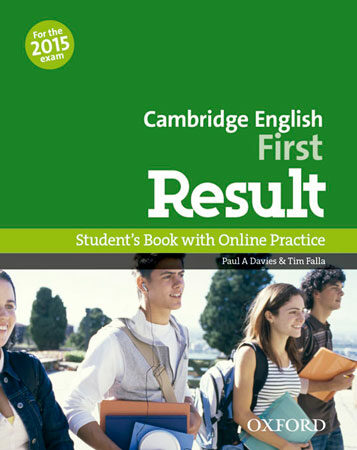

- Davies, P. A. and Falla, T. Cambridge English First Result Student's Book with Online Practice. Oxford: Oxford University Press.
- __________. Cambridge English First Result Workbook Resource Pack. Oxford: Oxford University Press.
CALENDAR
- Drop out due date: Tuesday 04 September.
- Holidays: Monday 19 November.
- Christmas holidays: from 20 December to 04 January.
- End of the course: Monday 17 December (Second midterm exam check)
- Dates of issue of academic records: 14 and 15 January 2019.
- Assessment:
- 1st midterm exam (Units 1-3): 08, 10 and 15 October.
- 2nd midterm exam (Units 4-6): 05, 10 and 12 December.

ASSESSMENT
- Assessment of 5 skills:
- Reading (20%)
- Writing (20%)
- Use of English (20%)
- Listening (20%)
- Speaking (20%)
- The final grade is the average of the two exams.
- Passing grade: 80 pts. and 80% of attendance (maximum number of absences = 6; but 5 consecutive absences are cause for dismissal)
OTHER ASPECTS
- The use of the Workbook is mainly at home. Be ready for its checking after each unit.
USEFUL SITES
- Facebook: CELe UAEMex
- Facebook group: CELe FCE1
- FCE Result
- https://www.cambridgeenglish.org/exams-and-tests/first/
- Cambridge exam preparation
- https://www.englishaula.com/en/
- Teacher's email: flamenca.rt@gmail.com
BIBLIOGRAPHY
- Bourke, K. and Maris, A. (2006). Grammar for FCE: Upper-intermediate. Oxford: Oxford University Press.
- Prodromou, L. (2012). Grammar and vocabulary for first certificate: for students preparing for the Cambridge English First exam. Harlow, England: Longman: Pearson Education Limited.
- Swan, M. (2005). Practical English Usage. Third edition. Oxford: Oxford University Press.
- Vince, M. (2009). First Certificate Language Practice: English grammar and vocabulary. Fourth edition. Oxford: Macmillan.
Suscribirse a:
Entradas (Atom)